There are two kinds of viewing checklist. One is a list of questions for whoever is showing you round — we published that one. This is the other kind: the things you establish yourself, by looking, with nobody answering.
They matter because they are the ones a photograph is structurally unable to show you, and because nobody can talk you out of what you observed.
In the room
1. Stand where the desk is and look at the light. A room photographed at 11am in June is not the room you will work in at 4pm in November. Find the window, work out which way it faces, and decide whether the desk is positioned for daylight or for a wall.
2. Close the door and listen for thirty seconds. Corridor noise, the lift, the heating, the street. Thirty seconds of silence tells you more than any description of “quiet”.
3. Open the wardrobe or count the shelves. Storage is the thing people discover is insufficient in week three. Picture your actual clothes in it, not a suitcase.
4. Measure the walk from bed to desk. In a small room these two pieces of furniture fight each other. If you cannot pass between them with the chair pulled out, you will be working on the bed by October.
5. Check the lock on the bedroom door. It should exist and it should work. In a shared suite this is not paranoia — it is the difference between a private room and a room with a door.
6. Find the plug sockets. Count them, and see where they are relative to the desk and the bed. A room with two sockets behind the wardrobe is a room with an extension cable.
7. Phone signal. Check it standing in the middle of the room, not by the window. If you are arriving from another country, this is also your first weeks of calling home.
In the shared parts
8. Stand in the kitchen and picture four people in it at 8am. The single most useful ten seconds of any viewing. Counter space, chairs, whether two people can pass behind a pulled-out chair. The longer version of this test is here.
9. Open the fridge and divide it by the number of bedrooms. Total capacity is the wrong number; your share is the right one.
10. Run the shower. Pressure and how long the hot water takes. Then work out what that means with four people and a 9am start.
11. Look at the bathroom at the ratio it actually serves. Ask how many bedrooms share it, then look at it again with that number in mind. (Here it is four, in both buildings.)
12. Walk out of the front door and start a timer. Walk to the building you will actually be in most days — your faculty, the hospital, the library. The number you get is the one that matters, not the one on the listing.
What you can check against, here
So the list above is usable rather than abstract, these are the fixed facts for our rooms:
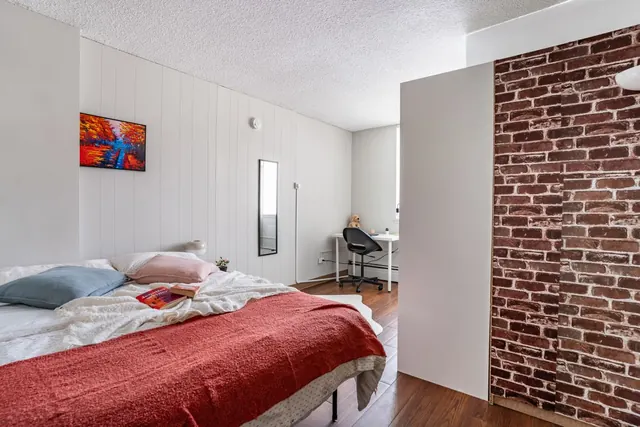
- Every room has a full bed with linens made up, a study desk, a desk lamp and shelving. Most types add a wall-mounted television.
- Floor areas, where we have measured them: Flex Basic 180 sq ft · Flex Plus 225 sq ft · Deluxe 235 sq ft, all at Garneau Towers.
- Four bedrooms to one bathroom and one kitchen, in both buildings. No private-bathroom option exists.
- Locks on the bedroom as well as the suite; controlled entrances and cameras at the door.
- The walks: from University Tower the Education building is five minutes and the hospital four; from Garneau Towers, seven and six.
What “furnished” should mean covers the definitional side — what the word is supposed to include before you ever stand in the room.
If you cannot be there in person
Most of our residents are not in Edmonton when they decide. A video tour covers nine of the twelve above if you ask for them specifically: ask the person holding the camera to close the door and stay silent, to open the wardrobe, to run the shower, to stand in the kitchen and turn slowly, and to walk out of the front door and keep walking.
That is a reasonable thing to ask for, and an operator who will not do it has told you something. Book one here — in person or over video.