An unfurnished room advertised below a furnished one looks like the better deal, and over a long enough tenancy it is. Over an academic year it usually is not, because the saving is spread across nine months and the cost lands in the first fortnight.
Here is what actually goes into that first fortnight.
What you buy before you can live there
- A bed frame and a mattress. The single largest item, and the one you cannot postpone.
- Bedding. Sheets, a duvet, pillows.
- A desk and a chair. For nine months of coursework this is not optional; working from a bed has its own cost.
- A lamp. Edmonton in November gets dark early enough that overhead light alone makes evening work miserable.
- Storage. A wardrobe or shelving, unless the room has built-ins.
- Kitchen basics, if the shared kitchen is unfurnished too — pans, plates, cutlery.
Then the logistics: getting all of it to the room. If you have just arrived in the city, that means delivery fees or a rented van, and a weekend that was supposed to be for settling in.
What you set up before it works
Four accounts, in your name, each with its own start date and possibly its own connection fee: heat, power, water, internet. Each has to be opened in September and closed in April or May, and the closing is its own small administrative job at exactly the point in the year when you have the least attention to spare.
Heat is the one to look at hardest. In an Edmonton winter it is not a rounding error, and an unfurnished listing that excludes utilities is quoting you a number that does not survive January.
What you get back in April
Less than you paid. A used mattress is close to unsellable; a desk and a chair fetch a fraction; the lamp and the shelving usually go to the kerb because the effort of selling them exceeds their value.
That is the part people forget when they run the comparison in September: the furniture is not an asset you recover, it is a cost you amortise — and nine months is not long enough to amortise it.
What the furnished figure covers here
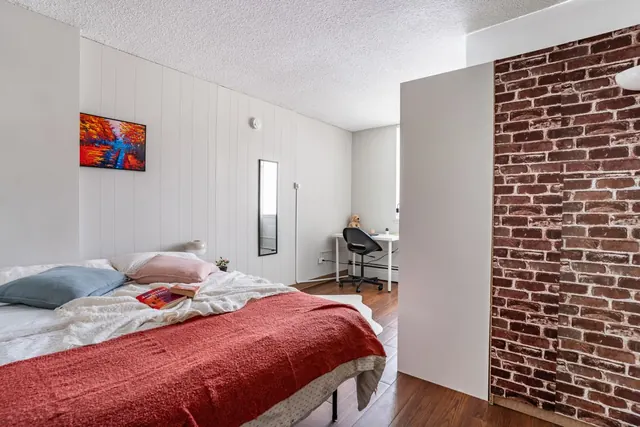
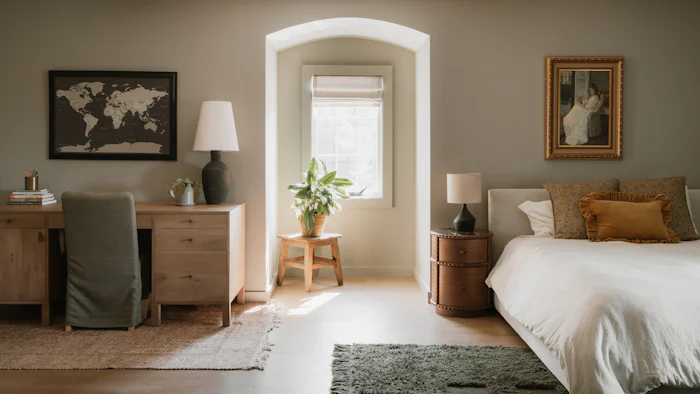
Every room in both buildings arrives with a full bed and linens made up before you get there, a study desk, a desk lamp and shelving. Most types add a wall-mounted television. The suite’s kitchen and its dining or sitting area are furnished too.
The four-weekly rent covers heat, water, power and Wi-Fi, laundry in the building and on-site maintenance. No utility accounts, no connection fees, no service fee, no application fee. Rooms run $560 to $880 depending on the room and the building — the cheapest is at Garneau Towers, and the University Tower Flex Basic is the closest to campus at the lower end.
When unfurnished genuinely wins
Three cases, and they are real.
You are staying several years. Buy once, amortise across three or four years, and the arithmetic flips decisively.
You already own the furniture and it is already in Edmonton. Then there is nothing to buy and nothing to resell.
You need a specific setup — a particular desk, a specific chair for your back, equipment that does not fit a standard room. A furnished room is a fixed configuration, and if it is the wrong one, no saving compensates.
Outside those, for a nine-month term, the furnished figure is usually the smaller total even when it is the larger rent.
The check that settles it
Write out both first months in full — rent, deposit, furniture, delivery, four connection fees, first bills — and only then compare the monthly numbers. If the furnished option is within about a hundred dollars a month, it has almost certainly already won.
The full price list is here, or book a tour and look at what “furnished” means in this building rather than in a listing.